Your definition of AI native will fail you
“AI native” is a powerful but slippery phrase. There's just enough consensus on its definition that we assume shared understanding, and enough room for interpretation to be dangerous.
I think most of our definitions start somewhere like IBM’s:
Systems, products, and operational workflows designed from the ground up with AI as a core component, not bolted on later as a mere feature.
Businesses, teams, and people are performing cargo cult rituals to market themselves as AI native, while working from a definition that’s driven by mechanics and not outcomes. It’s isomorphic mimicry, adopting the outward appearance of successful peers as an empty signifier of your own credibility.
And I think this is, in part, because of the framing the phrase “AI native” itself creates.
There's an implicit callback to the digital native, whose early exposure to technology was assumed to translate into technical ability. It didn't.
Immersion in a technology might build conversational aptitude, but not critical fluency. Exposure to technology alone doesn’t teach you how to use it well. We shouldn’t repeat the mistake of conflating familiarity with fluency when it comes to AI nativeness.
By that definition, there’s only one way to become more AI native: volume. But trying to prove AI nativeness by how much AI you use or expose in your product will eventually lead teams to rip out whatever was there before—regardless of the value it provides—and replace it with AI…regardless of the value it provides.
Since I don’t know we’re escaping the phrase, I'd propose an alternative interpretation—one that I think encourages better decisions.
Alternative framing
In the prevailing framing, our products, our processes, our people are meant to be native to AI: AI is the new world everything is built to fit. But that’s backwards.
Human behavior is still the defining context we build technology in, and while human behavior can change in relationship to technology, it happens slowly within some pretty firm constraints set by the goo and meat we use to interact with our world.
The human motivation to create, communicate, and yeah, sell is what gives our products value.
Instead of considering how we build our products to fit the world of AI, we should be thinking about how to build AI that behaves like a native species in the ecosystem of human behavior.
Products in which AI feels native need to account for all inhabitants of the ecosystem in order to be successful. Otherwise, instead of thriving like a native species, AI initiatives:
- Dry up and die or are kept alive at great expense, like an imported ornamental grass
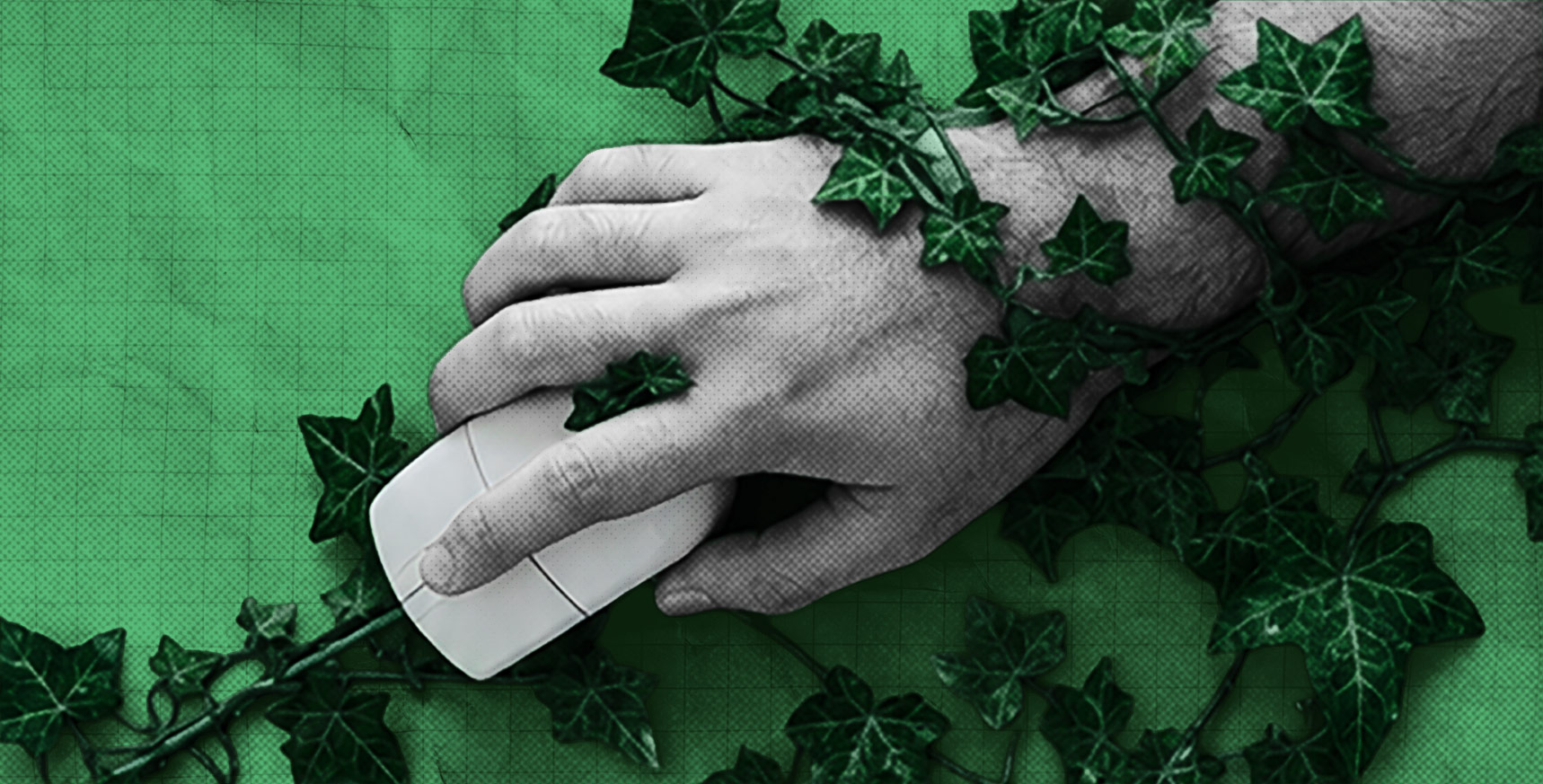
- Act like an invasive species, strangling out other sources of value and eroding the experience.
And I do think there are environments in this ecosystem that should be inhospitable to AI.
We need to look at products through the dual lens of what AI is capable of and what we know about human behavior and cognition. Here’s what I see as essential to an AI native product through this lens.
Reflect intent
The promise of natural language processing is that all you need to achieve your goal is intent. This is a legitimately cool aspect of AI that opens up new worlds to people regardless of their past education. But users don’t always come with clear intent, and language is not the best way to express all intents.
So AI native products need to be able to intuit, refine, capture, and play back users’intent. And we really need to find ways to do that other than chat bots.
Making interfaces more intent or goal-oriented, and building modes into agents can make implicit intent more reliable to intuit. But users also need new modalities and inputs to express intent.
Act as scaffolding
Interfaces will become increasingly fluid. At some point, that fluidity may come from generative UI; but there’s a huge amount of area to explore today by letting an agent manipulate the display of the existing UI to fit the user.
Users can work at the level of abstraction that’s right for them, creating a network of self-paving desire paths. For example: turning agent-driven adaptations of the user’s workspace into presets they can switch to at will.
To be scaffolding on which new experiences can evolve over time, you need a sharp content model and strong design system to create structure and consistency while still adapting to the user.
Digital experiences have evolved to reflect human users’ sense of place, and digital workflows rely on muscle memory. An AI native product needs to be more rigorous in its pursuit of clarity than one whose quirks can be learned over time because it never changes.
Work from a shared, natural language
AI is evolving alongside deterministic technologies, not replacing them. In the long-run, maybe only one survives—that’s not my bet—but just like early hominids, there’s going to be some coexistence and intermingling in the meantime.
All interactions in your product, whether mediated through AI or not, should reinforce the same mental model, even if they’re presenting the model at a different level of abstraction.
Some users may interact exclusively through knobs and dials to refine an agent’s work and others may send code that interacts directly with your foundational documents through an MCP. But most users will rarely work one way, at one altitude, all the time.
We shouldn’t make assumptions about users based solely on whether they favor deterministic or agentic interfaces. We’ve done this before with the advent of mobile experiences.
We assumed that the use of mobile technology was enough to determine the user’s context, what they’re trying to do, and what features they would need access to. We created dot-em sites catered to users on-the-go, only to find out they were visiting our mobile sites while sitting on the couch.
If we assume too much about the user from the technology they gravitate to first, we risk building them into a deep silo that limits the value they can derive from our products. Generative and agentic AI can and should meet the user where they are, but those interactions should also build the user’s intuitive understanding of the product outside the prompt box.
We need to be aware of drift in language (actual and visual) between agents and the rest of the interface.
I think successful AI native products will be least flexible with their content model, opinionated about what paths through that model they prioritize, and open-minded about how the system presents those paths to individual users.
Offer concurrency and scale with a controlled blast radius
We’ve been asked to do more with less long before generative AI. The volume and speed of AI production can be beneficial. But systems need to be transparent and open to participation by humans to avoid slop, cognitive surrender, and errors with a high blast radius.
This is more than human-in-the-loop. It’s using human cognition and behavior to set the loop’s circumference. It’s not enough to invite human participation into the process at fixed checkpoints if they can’t also make sense of what’s happening before or after. If users are being asked to “review” more decisions than the human brain can process, that’s a sign you’re doing AI invasive product design, and you need to do some weeding.
Avoid deskilling or die
While some users may say they want AI to do everything for them, keeping them engaged is critical. There’s a symbiotic relationship between effort and satisfaction. There’s evidence that encouraging people to let the AI handle everything leads to reduced motivation, satisfaction, and competency over time.
Deskilling, demotivating, or disenfranchising users is an existential threat to your product.
Sure, there are products out there who are hated by their users and survive regardless. Few of us will make it to that position. And why would we want to?
It’s impossible to manage this tension if your definition of AI native boils down to “AI only.” It requires hand-off between AI and human execution. It means building products that encourage users to do their own thinking first and treat the outputs of AI as material they should expect to refine. It means building pathways to learning into every interaction so usage doesn’t become dependency.
Of course, providing new ways of doing something will soften old skills. The ability to set metal type became less critical, then knowing how to use Letraset. Maybe some day my use of a keyboard will seem artisanal.
We should distinguish between what operational skills are needed to achieve something inside a specific product and the larger cognitive and domain skills humans need to do the thing themselves. Most importantly, we should use that distinction, along with the other principles above, to make principled decisions about where and how to use AI in our products.


