Transcript
I'd like to talk to you about the future of the systems we design. But first I want to share a bit of history.
My husband and his brothers were born and raised in Trinidad, so I'd like to start with a bit of Trinidadian history I picked up on a trip to see where he grew up.
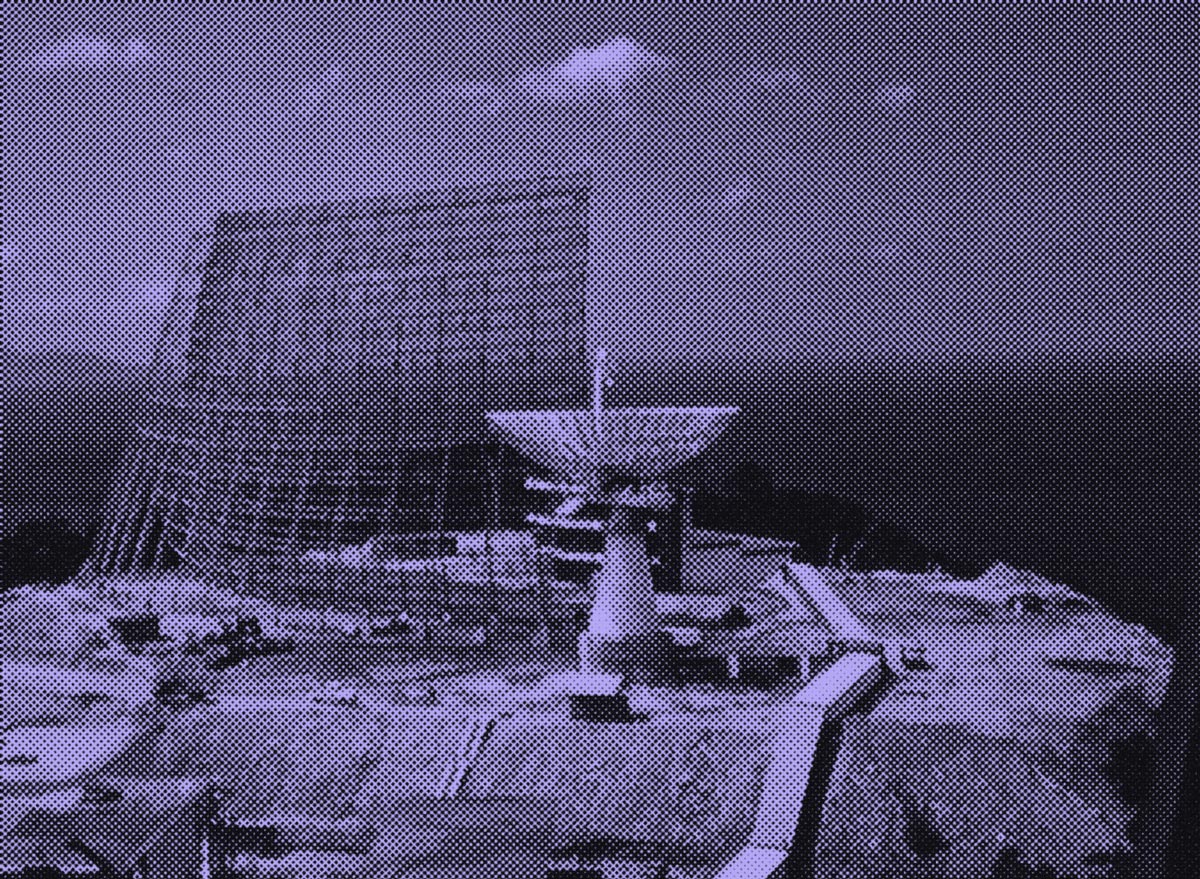
Chaguaramas Tracking Station
The Chaguaramus Missile Tracking station in Trinidad and Tobago was constructed in 1958.
It was an early warning system built by the US during the Cold War to detect missiles before they reached American soil.
It was the first of its kind in a global network of similar bases. It was used to track Sputnik three, and in 1960, the first ever intercontinental voice message relayed by satellite was sent from there.
The tracking station was a prototype for technology that would become cell phones, the internet, satellite radio, and GPS.
But the story of Chaguaramus is not just about technological innovation.
The American government gained the right to build its space on Chaguaramus, not from Trinidad and Tobago, but from the uk, which had colonized the islands over the course of the 19th century.
In 1940, land rights to the Peninsula and Trinidad were among those exchanged by the UK for 50 naval ships in the destroyers for bases deal.
To make room for the bases the people occupying that land were cleared out and the surrounding beaches were closed to the public in 1941.
So this technology from one angle, a symbol of innovation, was also seen as an ongoing symbol of extractive colonialism.
In the 1960s. The Chaguaramus issue was a focal point in the fight for sovereignty, which Trinidad and Tobago gained in 1962. Control of the peninsula was handed back to Trinidad shortly thereafter.
The missile tracking station stands now as a symbol of a different kind of progress. Although it is not standing very well.
The original structures are no longer sound, they've rusted and fallen, and nature has relayed its claims in the cracks and corners of what remains.
There's something bittersweet when historical sites fall into disrepair.
As technologists, I think the tracking station reflects something of our work and raises questions about its long-term consequence.
Many of us understand our work designing systems as acts of innovation and building, but I also find it reassuring that when everything falls apart at the seams, something wild will grow back in. The openings created. It's a reminder of the much larger system we exist in, not networked, but interconnected, self-sustaining and resilient, a system that will continue long after we're gone.
Why doesn't that evoke our work for us? I don't think any of us building design systems today helped construct the early warning system at Chaguaramus. So whether we see our work in the radar tower or the ecosystem that's reclaimed it, both are metaphors for what we're actually doing. And the metaphors we use to think and talk about our work shape, the direction it takes.
Metaphor and the Framing Effect
We use metaphors every day in our work. Metaphors help us communicate what we do without having to explain everything from the ground up.
Atomic design is a framework built on metaphor. It leverages our shared understanding of structures from an outside domain to help build shared ways of working within our own.
And who hasn't leaned on the metaphor of a Lego kit to explain a design system?
Metaphor is a medium for information. It reduces the effort the sender needs to invest in sharing it while increasing the likelihood the receiver will understand it. But two things happen when you use metaphor to transmit an idea.
One, the complexity of the original information is reduced to fit more neatly in the metaphor. Two, the information received picks up added meaning from the metaphor itself. The additional meaning from the metaphor can influence how we think, feel, and act in response to the information.
Consider America's war on drugs. A metaphorical war fought at home, beginning in the 1970s despite being a metaphorical war. The policies of the war on drugs increased surveillance and imprisonment decimated communities. And cost lives. That's an abysmal failure of health policy, but it's pretty much what you'd expect from a war, right?
Framing these policies as a war primes us to think of the people they targeted as enemies to public safety and the damage to communities as acceptable collateral damage. This effect, the reduction in complexity, the transference of additional meaning is precisely why metaphors are so powerful as a framing device.
Once we accept the basic premise of a conversation's framing, we will subconsciously make the other pieces fit.
Metaphor is just one type of framing. Device, though word choice, tone, imagery, and emphasis can all be used to influence the decisions we make. This is the framing effect. Our brains use framing as a shortcut for decision making.
Frames filter out information from our consideration, influence the criteria we evaluate it by, and bias us towards some actions over others.
Even if you disagree with something that's been said, if you argue against it without challenging the framing itself, you've already seeded ground. The frame is the foundation upon which every next decision is made.
And that's why I want to talk with you today about framing as we discuss the future of technology and our discipline.
The future is not a fixed destination we can predict. It's the outcome of conversations we are actively participating in, and those conversations are happening within framings we have not set and may not even be aware of.
If we want to play a leadership role in conversations about the future of design systems and the technology they're used to build, if we want to shape that future, we need to learn to recognize these frames for what they are and reframe conversations that are heading in a direction we don't support.
I will tell you now that I'm not going to tell you what I think the future of technology is. What I want to convince you of today is that the possibilities are much broader than we've been led to believe.
Our vision of the future has been intentionally narrowed by the framing devices we use to discuss it.
The future of technology seems to be all but synonymous with the future of AI right now, and I don't know if you've heard this, but something I hear a lot is it's all so new. How could we possibly know how things will turn out? We've never seen anything like this. We just have to build the technology, wait and see.
And yes, we continue to live in unprecedented times, but newness is also being used as a framing device. It's being used to keep us from bringing existing shared knowledge into the conversation.
I don't think that's very fair. It doesn't create much room for participation. It doesn't give you or me many tools to help build that future. I'd like to reframe the conversation because I don't think it is all that new. I think it's a conversation we've been having for over 200 years.
The Luddite Rebellion
In many ways, we're still trying to answer the industrial revolution's machinery question. Which wasn't just one question, but many in response to the transformative technology of their day and the automation it enabled.
How do these machines change the nature of work? What will they do to employment? What will these changes mean for communities, for society? And are the economic benefits worth the unpleasant effect on the environment in and around industrializing cities who will see the benefits and who will bear the costs?
Perhaps the most famous response to the machinery question is the Luddites who smashed the machine's driving automation with hammers.
Even if you're unfamiliar with the details of the Luddite uprising, you've undoubtedly heard the term. It's been thrown around a lot to describe critics of AI. We're told we need to pick a side between the visionary techno optimists against the Luddites who hate technology and want to stand in the way of change.
This intentional framing implies the only possible outcomes are either change good or no change bad. But believe me, there are more possible futures than the one very specific vision of technology being offered and doom. This framing misrepresents history to win a debate about our future.
At the turn of the 19th century, British society was burdened with the cost of extended warfare, rising unemployment, and high tariffs.
Try to imagine what that was like. If you can.
Water wheels and steam were powering machines that could outproduce individuals using traditional methods at unprecedented scale for a fraction of the cost. Work moved to the factory for skilled tradespeople who until then had worked from home with flexible work weeks.
And at the factory, their work was no longer valued as highly because the machines could be operated by fewer, less skilled, lower wage workers. Again, imagine if you can
The factory model split labor into steps isolating workers from each other. This, combined with the fact that labor organizing was literally illegal, led to awful working conditions for previously valued craftspeople, and the children who were working the machines alongside them.
This is what the Luddites were against.
Not the machines themselves, not progress, but the exploitation they were being used to justify.
Their demands were not for the wholesale abandonment of technology, but rather for things like progressive adoption that was less disruptive to communities, better compensation and working conditions, and higher standards for the goods being made.
The Luddites didn't raid factories to break machines until their demands were ignored, and even then, they only damaged the machine's driving automation, and they skipped the shops that treated their workers well.
But in 1812, machine smashing was made a capital offense. In 1813, 17 Luddites were executed under the law.
By the end of the Luddite uprising, 40 to 50 Luddites had been killed. For comparison, the Luddites only ever killed one factory owner.
And still, at one point the British government dispatched 14,000 soldiers to protect factories and put down the riots.
The historical reality of the Luddites has been mistold to support a narrative of inevitability. Because the Luddite uprising was eventually quelled and the industrial revolution continued, there's no point in trying to change the shape of this new industrial revolution we're undergoing. Their vision of the future is inevitable and yours is futile.
Even at the time, the framing of inevitability was used by factory owners to pressure their peers. Adopt the machinery or be left behind by the march of progress.
But the Luddites resistance did slow the adoption of new machinery. It shaped public discussion and provided a model for future organized labor movements. The industrial Revolution took the shape it did in part because of the Luddite movement.
The Automation of Knowledge Work
The 19th century factory model changed not just physical but also mental labor .
English mathematician and inventor, Charles Babbage applied the factory model to thinking.
He proposed a method of management that, like the factory floor, divided work into its component parts for easier observation, quantification control, and automation.
Babbage also designed the analytical engine, a concept for the first mechanical programmable computer. Though never built in his lifetime, it would've automated the work of existing computers, which in the 19th century was a job title.
Computers were people, often women, who followed a method devised in the 18th century.
Advanced mathematicians developed formulas and algorithms that could be broken down into simple and repeatable steps performed by human calculators using values, worked out by computers who only needed basic addition and subtraction skills. This created a new hierarchy of knowledge work in which some forms of computation became unskilled labor.
The 19th century human computers were today's mechanical Turk workers.
The automation of factory labor and knowledge work in the 19th century both followed the same pattern. Take the knowledge of highly skilled workers, break it into its component parts, create systems to standardize and govern those parts, then automate the process, keeping control and knowledge at the top of the hierarchy.
Does that sound familiar? It's a dynamic that's playing out not only in the field of AI, but one we in design systems could be accused of perpetuating. After all, work needs to be standardized before it can be automated.
If we're concerned about what increasing automation will do to design and engineering, we have to reckon with our own role in making them automatable.
In many ways, the prevailing framing of design systems is built on the factory model, atomizing systems, and setting forth rules for their recombination to make them scalable and efficient. As a result, we in design systems, are responsible for reducing the amount of knowledge it takes to design and build a product. Now, it is absolutely fair to worry about automation through AI de-skilling designers and engineers, but we can't address that if we don't also address the human systems that have laid the groundwork for it.
Those systems incentivize automation. The desire to automate computation came in part from England's need for accurate logarithmic tables, for maritime navigation in its pursuit of colonial expansion.
Today's incentives are not so different.
This is another consequence of the framing of inevitability. It positions the machines themselves as drivers of neutral change and hides the lobbying of humans who stand to benefit economically from it.
When that disparity becomes visible, the next framing device is deployed. The promise of future benefits that justify disruption today.
When sewing machines were first invented, advocates imagined a world in which women who were already sewing clothes for their family would be so productive, they could clothe their entire community. What materialized in place of that vision were sweatshops .
When Eli Whitney invented the cotton gin, he hoped it would reduce the need for human labor to the point that the institution of slavery would collapse. Instead, processing cotton became so cost-effective demand exploded, along with the demand for enslaved people to pick more cotton. American slavery continued for another 70 plus years.
At the turn of the 20th century economist, John M. Keynes predicted that productivity gains would lead to a 15 hour work week by 2030, which is coming up. How many hours did you work last week? Was it close to 15?
And when was the last time you promised a colleague that if they would just adopt your design system, it would take care of the rote work of building inside your product so they could focus on bigger problems?
It's not that I don't believe these things are possible through technology, but they're not a natural consequence of the technology.
Those benefits won't just come to us if we build the tech and wait long enough. It's our responsibility to realize them. We need to talk about how to make them happen outside a framing of inevitability.
Because as we follow the techno optimism of the 19th century into the 20th, we'll see just how much will let happen in the present while we wait for the future.
Italian Futurism
In 1909, Felipo Tomaso, Marinetti wrote The Futurist Manifesto declaring an art movement that did not exist at the time. The Futurist manifesto preceded any futurist artwork. Marinetti truly manifested his movement.
He spoke of the future and wrote in the plural.
We intend to sing to the love of danger The habit of energy and fearlessness Courage, boldness, and rebelliousness will be the essential elements of our poetry.
It sounds like an ad straight out of Silicon Valley. Marinetti was a proponent of moving fast and breaking things.
Futurist artists depicted cars, trains, cyclists, and dancers. Using techniques meant to show motion and dynamism.
Futurist poetry abandoned syntax, and symbolism in favor of onomatopoeia and graphic disjointed typography meant to capture the rapid chaotic clashing of metal on metal.
Futurists, saw humankind's destiny in technology, and not just in a metaphorical sense.
They elevated technological progress from a neutral force to the answer to humanity's perceived shortcomings. They idolized the machine extended humano mechanical new man who wouldn't be limited by current human constraints.
Machines don't get tired, they don't sleep, they don't have families they need to earn a living wage to support. We're hearing the same things about AI today.
Techno chauvinism is the belief that tech is always the solution. Reframed as techno optimism, it's behind many conversations about the future today.
The benefits futurists anticipated from technology were nothing short of cultural revolution, spiritual transformation, and immortality. Maybe you've heard some of those same future benefits being promised today. It's not a coincidence.
In his techno optimist manifesto, Marc Andreessen paraphrases the Futurist Manifesto saying technology must be a violent assault on the forces of the unknown.
Today's futurists value the same speed, scale, and audacity. They frame technological progress as a moral good in its own right. The solution to humanity's failings.
The problem is when you look through shared frames, you risk developing a shared worldview. You see, the other movement defining text Marinetti is known for is the Fascist Manifesto, which he co-authored with Benito Mussolini. And that fact isn't a coincidence of authorship.
Marinetti supported fascism, not just because proximity to power would benefit himself and his movement, but because futurists and fascists had overlapping ideologies. Italian futurism was fueled by its own kind of nationalistic pride trying to establish an Italian art movement free of the French Academy.
Futurists and fascist were aligned in a desire to abandon intellectualism history, tradition, and the day's norms.
Marinetti was a veteran who described war as the world's only hygiene. Futurists saw veterans with mechanical prosthetics as prototypes for the humano mechanical man, and a way to prepare the imminent and inevitable identification of man with the motor war was also essential to obtaining the raw materials needed for that technology.
If you convince people technology is the answer to their problems, you can justify taking whatever it is you need to build it.
Futurists understood this violent aspect of automation and industrialization and embraced it, I think some of today's futurists do to. Why would we accept their vision of the future?
I think many of us in tech accept the frames of the innate value, inevitability, and future benefits of progress with without really understanding what that triangle points to.
Early Cybernetics
19th century laborers feared their transformation into automatons. While 20th century futurists looked forward to the identification of man with the motor. In the early field of cybernetics, a metaphor that brings us closer to that future rose in prominence.
The metaphor of the mind as a machine isn't just a common framing device used when discussing AI, it was core to the technology's development. In 1943, McCulloch and Pitts published the first mathematical model of a neural network. They borrowed concepts from electrical engineering to help understand the brain. They envisioned neurons as a net of individual nodes performing Boolean logic, allowing the brain to perform its computation.
In 1958, Frank Rosenblatt built on this conceptual foundation building the first physical implementation of a machine learning system. Rosenblatt's Mark One Perceptron could be taught to discern whether a card depicted a circle or a triangle, but it struggled to solve more complex problems like distinguishing an E from an F.
A decade later, mathematical proof the perceptron could never overcome these problems led to the first of two major AI funding winters. But in 1959, only a year after Rosenblatt developed his Perceptron, a breakthrough in biology highlighted a limitation, not with the technology, but with the conceptual model behind it.
The paper, what the frog's eye tells the frog's brain demonstrated that at least some visual information is interpreted by the eye before it reaches the brain. The brain isn't solely responsible for processing inputs from the outside world. McCulloch and Pitts model of a neural network preceded our scientific understanding of biological neural networks.
It wasn't an accurate description so much as it was a metaphor. That metaphor of the mind as a machine was a useful one. It eventually allowed us to build LLMs, but it's still a metaphor that obscures the complexity of what our brains do, as well as what the technology is actually capable of. Remember, when we understand a thing through metaphor, it takes on some color of that metaphor.
Building AI on a metaphor for the human brain, imbues it with some humanity in our minds. That's evident in the anthropomorphic language we use to describe it today.
Consider how AI copilots are being sold as your new junior developer or designer. We know that investing in the growth of a junior developer or designer will pay off in the future. Anthropomorphic framing implies if we invest in AI, we'll see similar returns as the field matures.
At the same time, it's increasingly hard for flesh and blood, early career engineers and designers to find development opportunities.
We're building AI agents with more agency than our human employees and users.
The Systems of Tomorrow
The humanization of technology and the dehumanization of people go hand in hand, but this is an avoidable consequence of how we're framing our work.
Marx wrote, it's not what is made, but how, and by what instruments of labor that distinguishes different economic epochs. The tools we use shape how work is done and what knowledge is needed to do it.
When the nature of work changes. So do our relationships and social hierarchies.
As we incorporate new tools into our work, which is itself about creating tools for others, we should ask ourselves, how will the tools we build define this new epic of work?
How we answer that question will shape not just its direction, but the future for everyone who uses the systems we build.
The hardest part is learning to see the frames we talked about today and understanding how they've set the direction of today's most important conversations. The frames we've built our discipline on aren't new. In fact, it's because we've been looking through them so long that they're so hard to see.
But we know what gets built when these frames go unchallenged.
Will we choose at this moment in time to rebuild the factory yet again? Or can we grow something interconnected, sustainable, resilient, and maybe even a little wild in its cracks?
What would our systems look like if they weren't framed by the metaphors of the atom, the machine, or the factory? How would we see them through the frames of the ecosystem, the body or the community? Would you automate the same processes? Would you invest your time the same way? Would you build the same things?
If we want to build something better, we have to find a new way to frame the future. We have to frame our work around people and in the direction of a future we want to see.
The systems we build may be built with technology, but they're for people. We are people and that is not a failing for us to overcome. The decisions we make will decide whether or not technology delivers its promised benefits, and whether or not its promises are weighed against its impact today.
Stop listening to people who say the way things are or the way they have to be, or that the future can only be one, maybe two things. Stop weighing the choice between inevitability and doom and start looking for the possibilities beyond that false binary. And when others try to set up frames that we know are harmful to people, it's our duty to each other in the future of our industry to like the Luddites, tear them down.